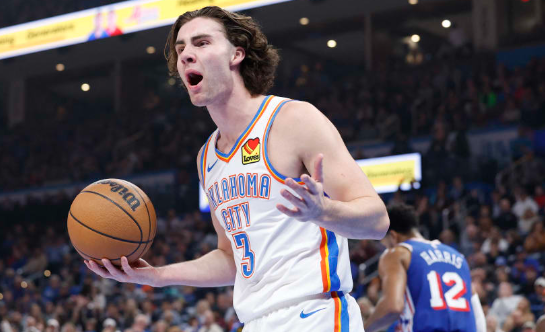
There’s been a ton of chatter on Thunder Reddit & Twitter on Josh Giddey being the focal point in the games that the Thunder lose. It had me thinking: what are the major key variables that define whether the Thunder win or lose? In order to address this, I conducted a regression on our wins & losses with many different data inputs to understand what variables are highly correlated to our outcomes. I first started high-level and then drilled into player specific variables.
Skip if you understand regressions: regressions will often tell someone what outcomes are correlated with different input variables — important to clarify, though, that it doesn’t provide causal relationships. When we conduct regressions, we often look at three important statistical values:
- R Square: This essentially says “how much of the puzzle is complete”; obviously, we would like to achieve a value of nearly 100%.
- P-value: There’s a certain confidence threshold that one can set e.g., 95%; which means anything that receives a p-value of less than 5% are variables that are considered significant to the puzzle e.g., this is a puzzle piece to the overall puzzle. Anything above 5% of the p-value means that the input variable isn’t one that’s heavily correlated with the outcome and could be considered noise.
- Coefficients: the larger the magnitude of the coefficient, the heavier the impact of that variable is on the outcome… assuming it’s p-value is less than 5%.
I took all the game logs & advanced box scores and conducted a regression on all the OKC Thunder’s games. There are two methods to conducting this regression: setting the outcome as binary dummy variables (wins or losses) or setting the outcome as the +/- differential (anything positive is a win; anything negative is a loss). I opted against the former because the magnitude of the wins should be captured (e.g., setting a dummy variable of 1 for a win doesn’t capture if the game was won by 35 points). Then, when defining the input variables, I chose 16 (thanks to Excel’s restrictions) and chose whether or not these 16 input variables have a heavily correlation with the Thunder’s wins or losses — the variables were as such:
- Steals
- Blocks
- Turnovers
- Assist % – of all fields goals we made; how many of those come on assists
- Defensive rebound % – of all rebound opportunities possible on the defensive end; how many of those did we win
- Rebound % – of all rebound opportunities possible in the entire game; how many of those did we win
- True Shooting % – metric for how well the team has shot by normalizing factors like the 3 point shot
- Pace – how fast are we playing
- Free Throw Attempt Rate – metric to measure how often we are getting to the free throw line e.g., how aggressive we are being in picking up fouls
- Opponent Free Throw Attempt Rate – metric to measure how often we are fouling the other team
- Points off Turnovers
- 2nd chance points – metric on how many points are we scoring after the first shot misses but there’s a continuation of our offensive possession
- Fast break points
- Points in the paint – metric on how many points we are scoring < 5 feet away from the rim
- Opponent paints in the paint – metric on how many points we are allowing < 5 feet away from the rim
- Opponent turnover %
The R-square for this model was relatively high at 82% which means there may be other variables not captured that drive the outcome of our games. When conducting the regression, we discover that 5 variables emerge as significant (less than 5% p-value) in defining whether the Thunder wins or loses games. The 5-variables are:
- Turnovers – Coefficient of negative 1.4. For every turnover we commit, we decrease our net differential by 1.4 points.
- Rebound % – Coefficient of 2.3. This had the largest coefficient of the five variables, which shouldn’t shock any Thunder fan who has been watching the games. Every 1% uptick in rebounding percentage gives the Thunder a +2.3 point differential. On the flip side, every 1% downtick in rebounding percentage gives the opposing team a +2.3 point differential. When the Thunder wins, we average a reb % of 48.9% — in losses, we average a reb % of 44.2%
- True Shooting % – Coefficient of 1.2. This is pretty straightforward: you shoot the ball well, you have a higher chance of winning. I was a bit intrigued to seeing that its coefficient wasn’t as high as one would think: a 1% uptick in true shooting gives the Thunder a +1.2 point differential. When the Thunder wins, we average a true shooting % of 63.5% while in losses we average a true shooting % of 56.7%.
- Opponent points in the paint – Coefficient of negative 0.4. In wins, we give up only 44 points in the point while in losses, we give up 51 points in the paint.
- Opponent turnover % – Coefficient of 1.82.
Okay, so the key to winning for the Thunder are: shoot the ball well; win the turnovers battle; and protect the paint & rebound.
I, then, did a deep-dive and looked at reb % and true shooting for starters to identify which starters have an impact on the outcome with these dimensions e.g., to address the initial question: does Josh Giddey impact our wins and losses the most out of our starting lineup?
Rebounding %: I, once again, set the outcome as the + / – points differential and looked at the advanced box scores to get reb % across our starters. Clarification here: because all of our starters didn’t play in all games together, we had to omit any data points where one of the 5 starters were missing. We still had a great sample size of 45+ games but worth caveating that the data set was slightly different. When we conduct the regression here, it actually turns out that no one player (across Lu Dort, Jalen Williams, Chet Holmgren, Josh Giddey, and SGA) has a p-value of < 5%. A partial explanation for this could be because Jaylin Williams is actually leading the team in reb % and he’s not included in this data set. It is worth mentioning that Josh Giddey does get close to having a p-value of 5% as his p-value comes out to be ~6%. In wins, Josh Giddey has a rebound % of 12.8% and in losses, Josh Giddey has a rebound % of 10.3%
True Shooting %: I did another regression, setting the outcome as the + / – points differential and brought in our starting 5’s individual true shooting % for each game. When conducting this regression, our R square is ~50% (which makes sense because we excluded a larger sample set with the bench players), and found that three players have p-values less than 5%. These three players are: Chet Holmgren; Josh Giddey; and Shai Gilgeous-Alexander.
- Of these, Shai has the largest coefficient by far: in games that we have won, Shai has had a True shooting % of 65.4% while in losses, he has had a true shooting % of 58.6%. This also makes sense, Shai often gets the most shots on the team; so his performance is going to drastically impact the outcomes of our games.
- Second and third highest coefficients were really neck & neck between Josh Giddey and Chet Holmgren, with Josh having a slightly larger coefficient in shaping outcomes of games. Josh Giddey had a true shooting % of 56% in wins and a true shooting % of 51% in losses. Meanwhile, Chet Holmgren has a much larger spread where in wins, Chet shoots an astounding 68% TS% while in losses, Chet shoots 50.3%. At least from an eye test, it always felt like to me that when Chet plays well, we win, and when he struggles to hit those pick & pop shots, we tend to lose. I’m a bit shocked to see the coefficients so close between Chet and Josh and figured to see Chet have a much higher coefficient.
So to say, Josh Giddey’s poor shooting is the main reason we lose is simply not true, although I’ve shared similar remarks before — I think it’s just far more attention-grabbing because he’s left so wide-open in the corner 3.
I actually listened to Down to Dunk in their episode Thunder Thump Magic on TNT + Who is Gordon Hayward and there’s a section where Andrew Schlect and Michele Berra discuss Josh Giddey. I tend to really take Michele’s point of view here when he talks about how it’s not the corner 3 misses that are glaring issues, it’s everything else.
I did one final regression on points in the paint because I was curious (when I did a regression on binary dummy variables, points in the paint emerged as a significant variable with p-value < 5%). When I looked at the starters’ points in the paints and tied it to the +/- outcomes, only one emerged as having a p-value <5% which was Josh Giddey. In wins, he averages 7.3 points in the paint while in losses, he averages 5.5 points in the paint. What is troubling for me is seeing him blow open layups in the Dallas Mavericks game, and his floater / push-shot doesn’t seem to be going down as easily this year. On Synergy, his runner is averaging a 43.5% from the field this year; last year, he was in the top 33% in the NBA with the field goal % of 48.7%. Similar story to his finishing around the rim: last year, he averaged 55.9% around the rim while this year, his finishing efficiency is at 52.9%.
I also understand Andrew Schlect’s point that Giddey is in a totally different role this year than last. Last year, he had a slightly higher usage rate at ~24% while this year, that’s down to 22% — probably not significant. However, the way he’s being used is totally different: last year, of the possessions he had, the most run play type for Giddey was in pick & roll as the primary ball handler and he averaged ~30.2% of his possessions in pick & rolls; this year, he’s primarily being used as a spot up shooter (and P&R ball handler is down to 19.7% of his possessions). I liked what Michele said in this podcast episode where there’s a chance to optimize our line-up by making Josh Giddey run our 2nd unit in the 2nd quarter whereas we often let J-Dub and Chet run that unit. There’s not a large sample size for Josh Giddey being the primary ballhandler this year, but our second best line-up in +/- this year was a lineup of Micic; Kenrich; Lu Dort; Giddey and Chet Holmgren with a +4. It was played in only 3 games. It would be interesting to replace Micic with Gordon Hayward and see how that lineup plays out. I think this would be nice for developmental reasons to boost Giddey’s confidence; however, during the playoffs, we have a recipe in place that provides us success with J-Dub and Chet running the second unit during the 2nd quarters and beginning of the 4th quarter.
All of this is to say: from a stats perspective, Giddey is considered an X-factor in our wins & losses but probably not to the magnitude of what fans on Twitter and Reddit are proclaiming. In this study, we’ve shown that Chet and SGA shooting performances also dictate whether or not we win or lose, with Shai having the largest coefficient of the three. True Shooting success is obviously one of the defining parameters that define whether we win or lose, but we also discovered that these other 4 variables are critical in defining our wins and losses (in decreasing order of coefficients): rebounding %; opponent turnover %; Turnovers; True shooting; limiting opponents paints in the paint.
I hope everyone enjoyed this article — let’s hope the Thunder finish post-ASG component of the season strong!
 RumbleRants
Leave a comment